
Photo Requirements & Examples
Learn exactly what makes a passport photo acceptable before uploading your picture.
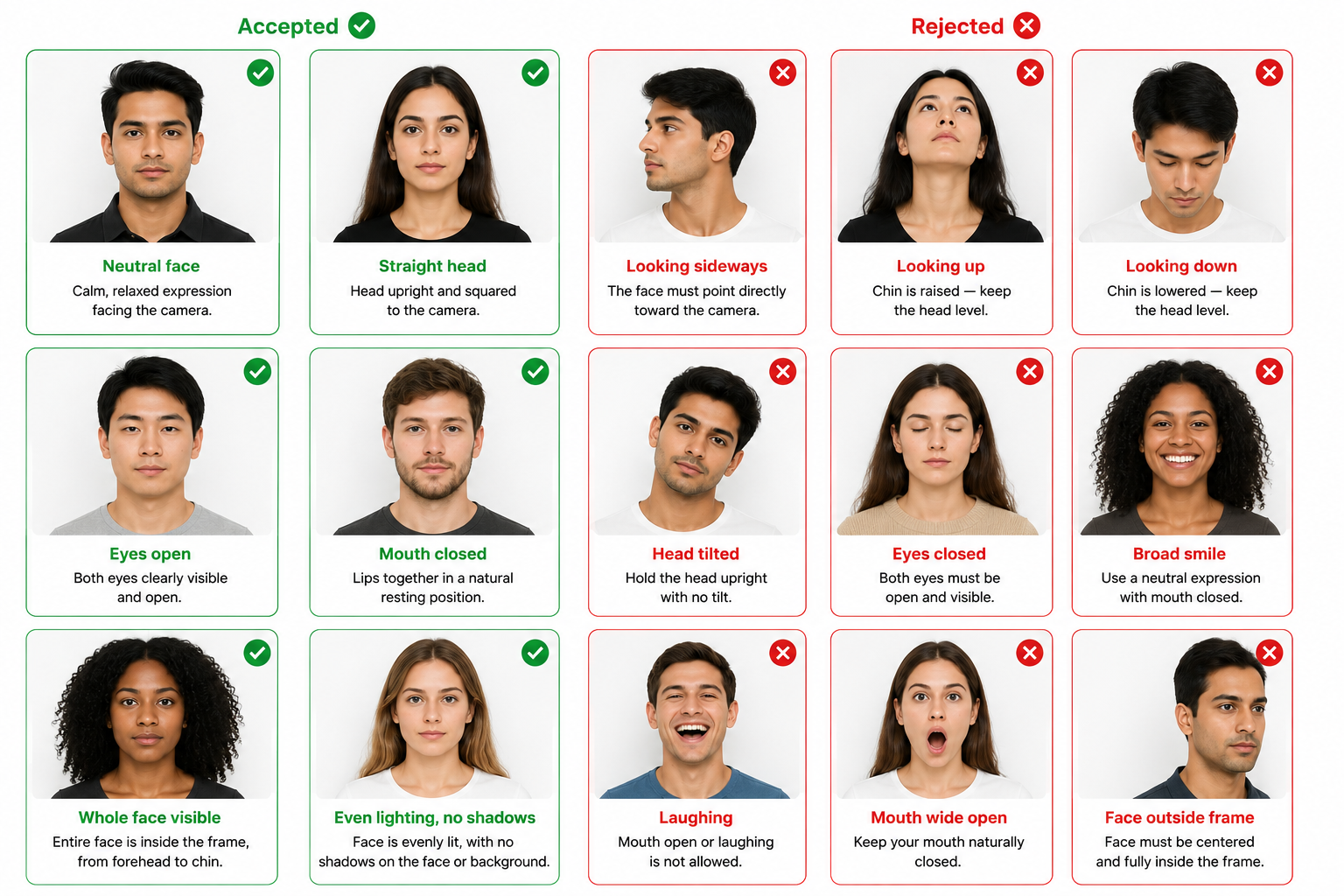
Your face must point straight at the camera with a calm, natural expression. The whole face needs to be visible and evenly lit, with no shadows. These are the rules examiners check most closely, so getting them right is the single best way to pass the first time.
Get these right
- Look directly at the camera
- Keep your head straight (no tilt)
- Face centered in the frame
- Neutral facial expression
- Both eyes open and clearly visible
- Mouth naturally closed
- Whole face fully visible
- Even lighting, no shadows on the face or background
Helpful tips
- •Relax your face and breathe out gently just before the photo is taken.
- •Have someone take the photo straight on, at eye level, about an arm’s length away.
- •Use soft, even light from the front to avoid shadows on one side of the face.
- •Keep both ears roughly level to confirm your head is straight.
Official recommendation
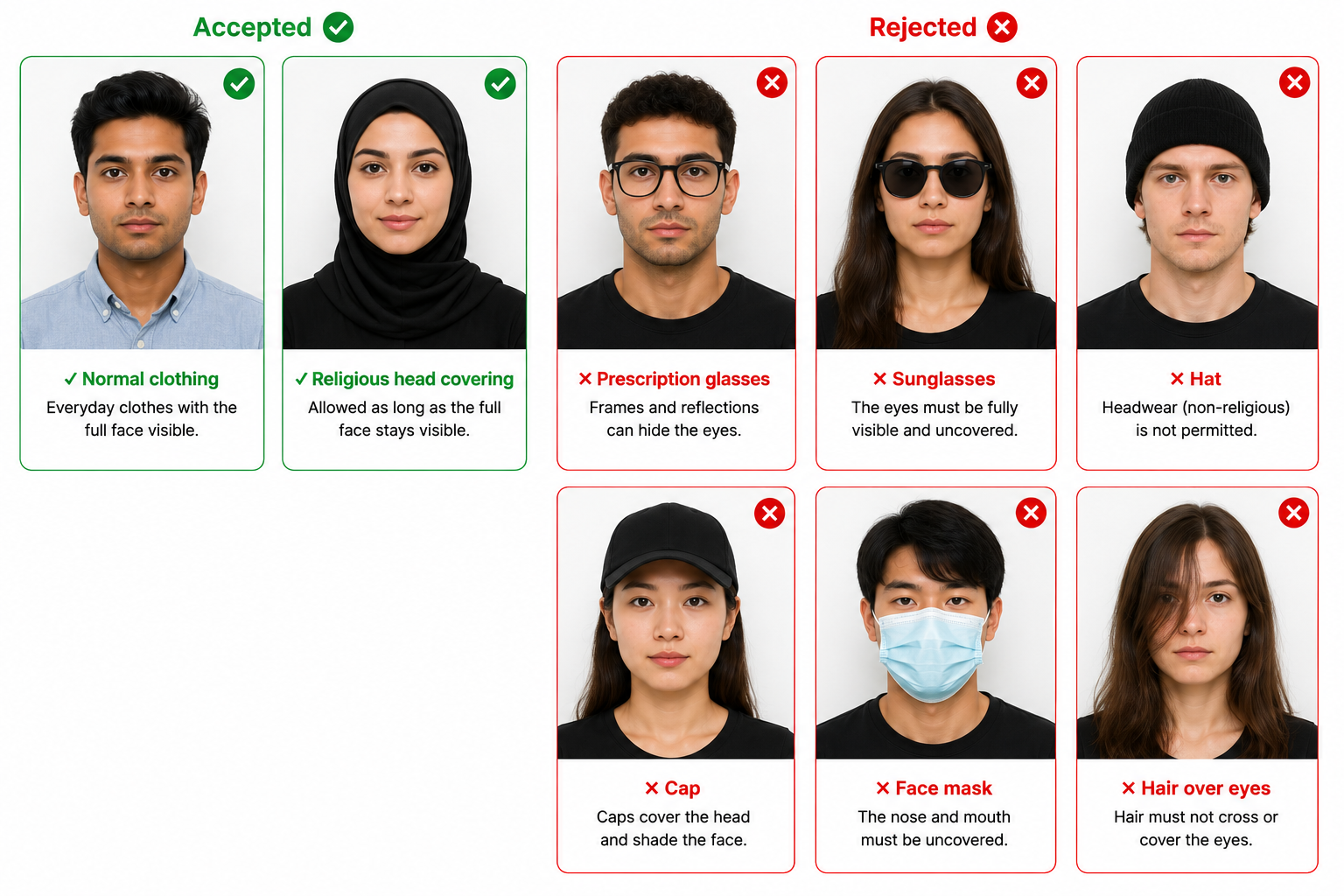
Everyday clothing is fine, and religious clothing is allowed as long as it does not cover the face. Glasses are not accepted because reflections and frames can obscure the eyes, which government systems must see clearly. Hats, caps, masks, headphones, and hair across the eyes are also not allowed.
Allowed
- Everyday clothing
- Religious clothing that does not hide the face
- Hair kept clear of the eyes and face
Not allowed
- Prescription glasses
- Sunglasses
- Hats and caps
- Face masks
- Headphones or earphones
- Hair covering the eyes
- Anything else hiding facial features
Helpful tips
- •Remove glasses entirely — even clear lenses can catch a reflection.
- •Choose clothing that contrasts with a plain white background.
- •Tuck hair behind the ears or to the side so both eyes are clear.
- •If you wear a head covering for religious reasons, keep the full face from chin to forehead visible.
Official recommendation
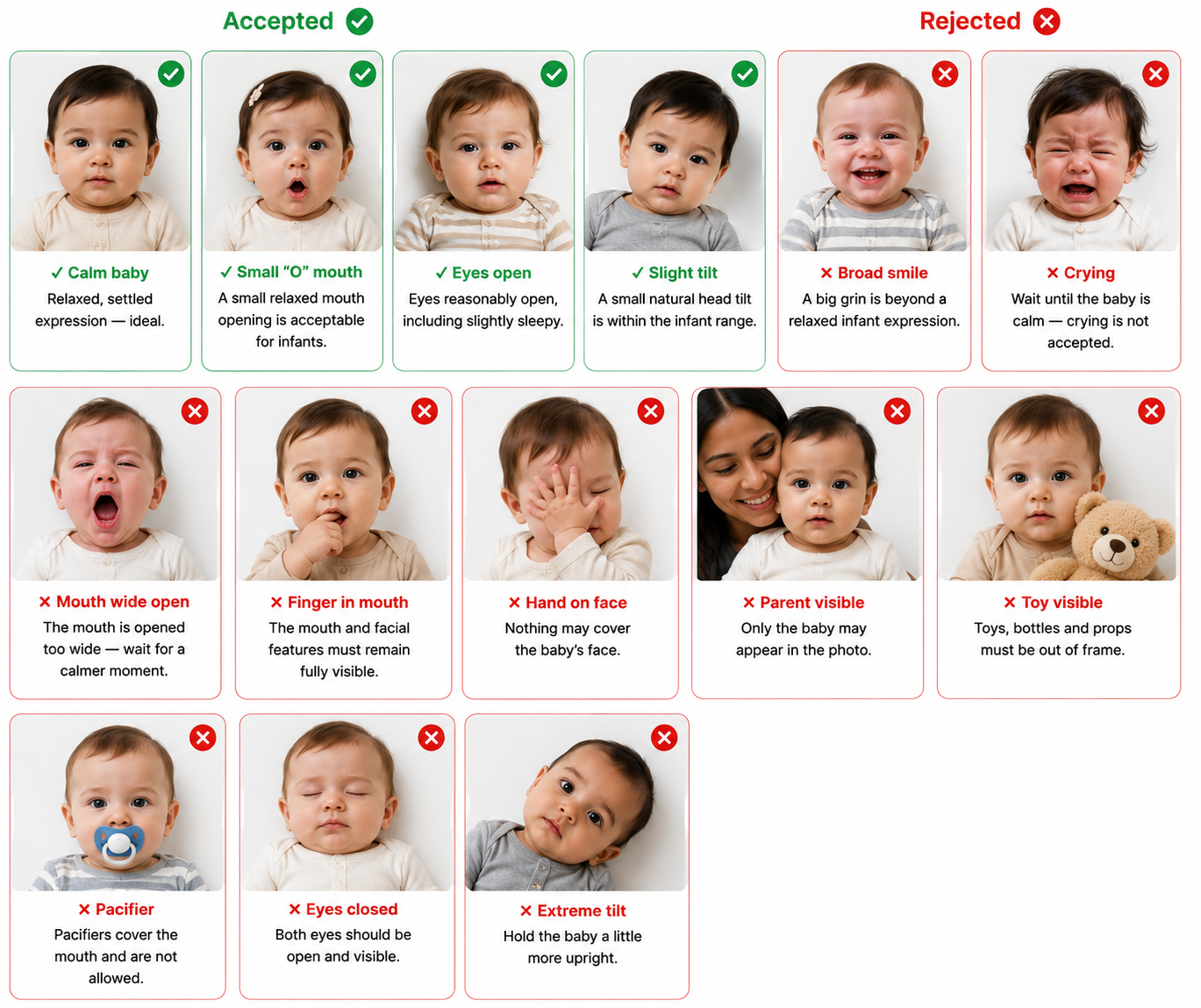
Baby and toddler photos follow different, more forgiving rules than adults. Infants breathe through slightly parted lips, can’t hold a perfectly neutral face, tilt their heads, and don’t always open both eyes equally — so those rules are relaxed. What still gets rejected is a genuinely non-compliant photo: crying, laughing, a wide-open mouth, fully closed eyes, an extreme head angle, or anything covering the face.
Allowed
- Calm, relaxed baby
- Relaxed face / mild natural expression
- Slightly open mouth or a small natural “O”
- Eyes reasonably open (slightly sleepy is fine)
- Slight head tilt
- Slight natural movement
Not allowed
- Broad smile or big grin
- Laughing or screaming
- Crying
- Mouth wide open / tongue out
- Finger inside the mouth
- Hand covering the face
- Parent, another child, toy, bottle or pacifier visible
- Blanket covering the face
- Eyes completely closed
- Extreme head rotation or tilt
Helpful tips
- •Lay the baby on a plain white sheet and photograph straight down from above.
- •Catch a calm moment — just after feeding or a nap often works best.
- •Make sure no hands, toys, pacifiers or blankets are in the frame.
- •A small open mouth or slight head tilt is fine; you’re only avoiding extremes.
Official recommendation
Ready when you are
Follow these requirements and your photo is far more likely to pass on the first try. Not sure? Our experts can review it for you.